Smart Booking Marketplace — A Case Study
From manual coordination to smart booking — how WhizCloud built a fully digital, multi-platform service marketplace
TL;DR
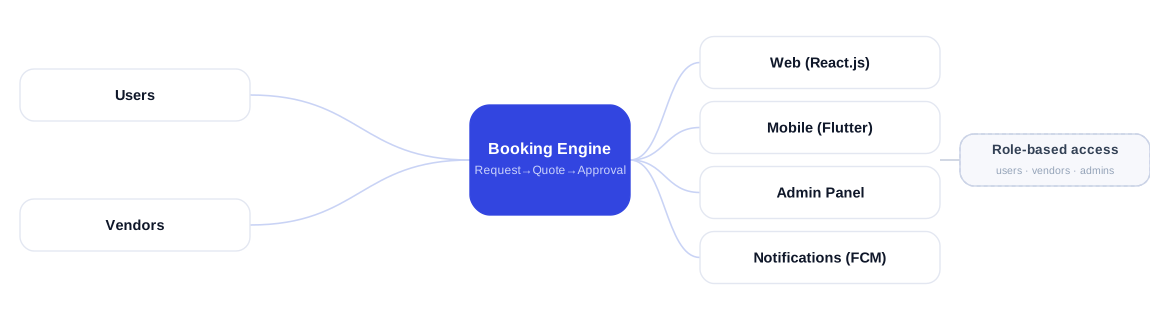
We partnered with a fast-growing client to transform a fragmented, offline service booking ecosystem into a fully digital, scalable marketplace platform. Using NestJS, MongoDB, React.js, and Flutter, we built a unified system where users can discover, compare, and book venues and services — from catering and photography to event spaces — across web and mobile. The result: a high-performance multi-platform marketplace with location-based discovery, a complete Request → Quote → Approval booking workflow, vendor and venue management, a powerful admin panel, and real-time notifications — eliminating manual coordination entirely and delivering a future-ready marketplace foundation.

Problem Overview
The traditional service booking process was inefficient, opaque, and impossible to scale. Users had to coordinate manually with multiple vendors, compare prices through back-and-forth communication, and make decisions without visibility into reviews, availability, or location. On the vendor side, lead management and booking tracking were equally fragmented — no centralised system existed for either party.
- Users relied on manual coordination with multiple vendors — slow, inconsistent, and error-prone
- No centralised system for price comparison or real-time availability across service categories
- Limited visibility into vendor reviews, quality, and location before making a booking decision
- Vendors had no structured way to manage leads, track enquiries, or handle booking requests at scale
- No digital booking trail — cancellations, modifications, and status updates all handled offline
Role & Responsibilities
- Role: Full-stack development team
- Responsibilities:
- Design and build the full marketplace platform — backend API, web frontend, mobile app, and admin panel
- Architect a multi-tenant scalable system supporting users, vendors, and administrators
- Build the complete booking lifecycle — request, quote, approval, completion, cancellation
- Implement location-based service discovery with GPS and manual selection
- Develop secure authentication — JWT, OTP flows, and Google Sign-In
- Build the vendor and venue management system with pricing, albums, reviews, and map-based location
- Deliver the admin panel covering user, vendor, booking, quotation, and content management
- Integrate Firebase Cloud Messaging for real-time push notifications across the platform
- Deploy the full platform on cloud infrastructure with CI/CD and managed MongoDB
Project Context
- Industry: Service marketplace — venues, catering, photography, and event services
- Purpose: Replace manual, fragmented service booking with a unified digital marketplace covering discovery, comparison, booking, and vendor management across web and mobile
- Constraints: Multi-tenant architecture supporting multiple service categories and cities, location-based discovery with GPS accuracy, multi-step booking workflows with quote and approval logic, real-time synchronisation across users and vendors, and data consistency across a high-volume booking system
My Approach
We began by mapping the full journey for both sides of the marketplace — how a user discovers, evaluates, and books a service, and how a vendor receives, responds to, and manages that request. The architecture was designed as a modular, service-oriented system with clear separation between the booking engine, discovery layer, vendor management, and notification services. The booking lifecycle was established as the core domain model before any frontend work began.
- Discovery: Mapped every touchpoint for users and vendors — from first search to completed booking — before any build work began
- Booking engine first: The Request → Quote → Approval → Completion lifecycle was designed and tested as the core domain before discovery and vendor features were layered on
- Parallel delivery: Web, mobile, and admin were built simultaneously against the same NestJS API — no feature divergence across platforms
- Scalable by design: MongoDB's flexible schema and the multi-tenant architecture were chosen from the start to support new service categories and cities without restructuring

Research & Insights
Key Findings from Discovery
- Users abandoned the booking process when they couldn't compare prices or availability in one place — consolidation was the primary conversion driver
- Location was the most critical discovery filter — users consistently narrowed by proximity before any other criteria
- Vendors needed structured lead management more than any other feature — untracked enquiries were their biggest operational pain point
- The quote and approval step was non-negotiable for service categories where pricing varies — a fixed-price booking flow would not work across all categories
- Real-time booking status updates were expected by users — any delay between vendor action and user notification caused confusion and support queries
Competitive Research
- Most service marketplaces were category-specific — none offered a unified discovery and booking experience across venues, catering, photography, and related services in one platform
- Vendor tools on competing platforms were limited to listing management — none offered a full quote and approval workflow with booking tracking built in
- Location-based discovery was common in consumer apps but largely absent from B2C service marketplace platforms in this space
User Persona
- Name: Ananya
- Role: Event planner booking multiple services for a corporate event
- Goals: Find and compare vendors by location and category, get quotes quickly, track booking status in real time, and manage all bookings in one place
- Pain Points: Chasing multiple vendors manually, no way to compare pricing transparently, no confirmation until a phone call is made, no record of what was agreed

Information Architecture
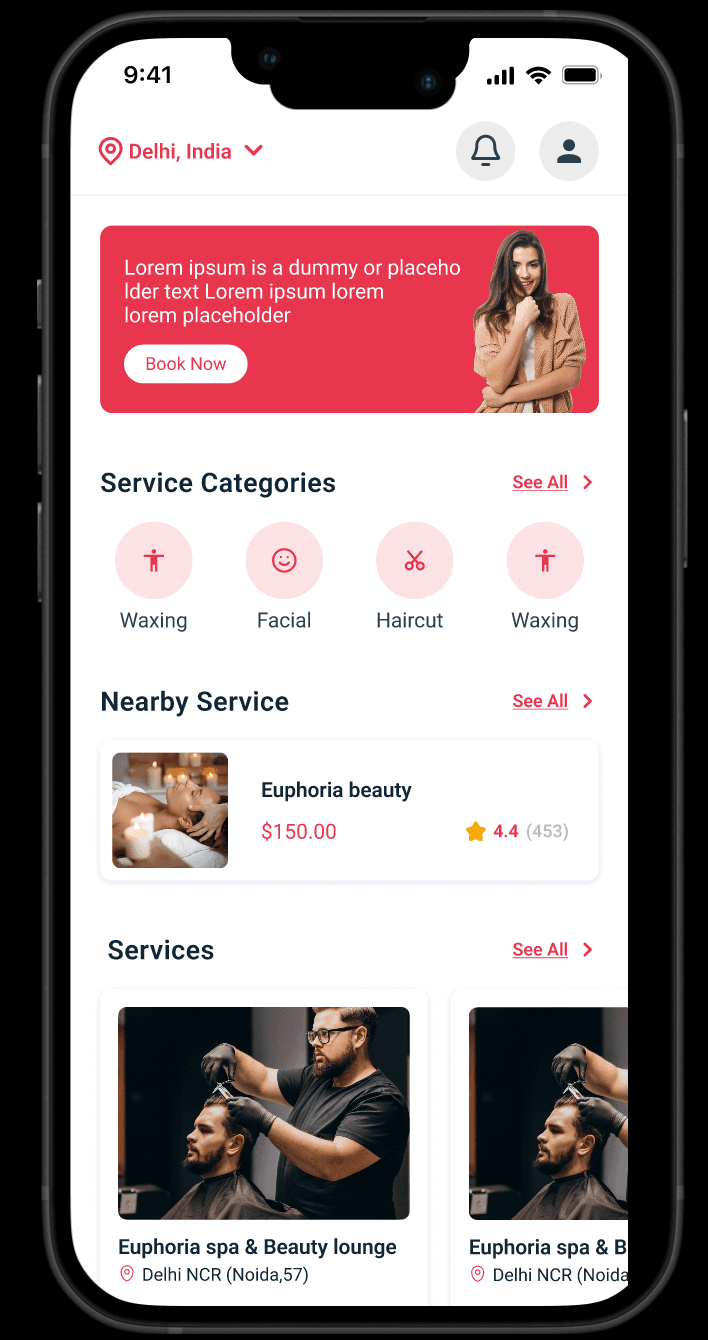
- Home & Discovery — location-based service listings, featured vendors, category-driven browsing, and recommendations
- Search & Filters — category, location, price range, and availability filters across all service types
- Vendor & Venue Detail — full profile with pricing, photo albums, reviews, similar service recommendations, and map-based location view
- Booking Engine — Request → Quote → Accept/Reject → Completion workflow with booking history, cancellation, and modification support
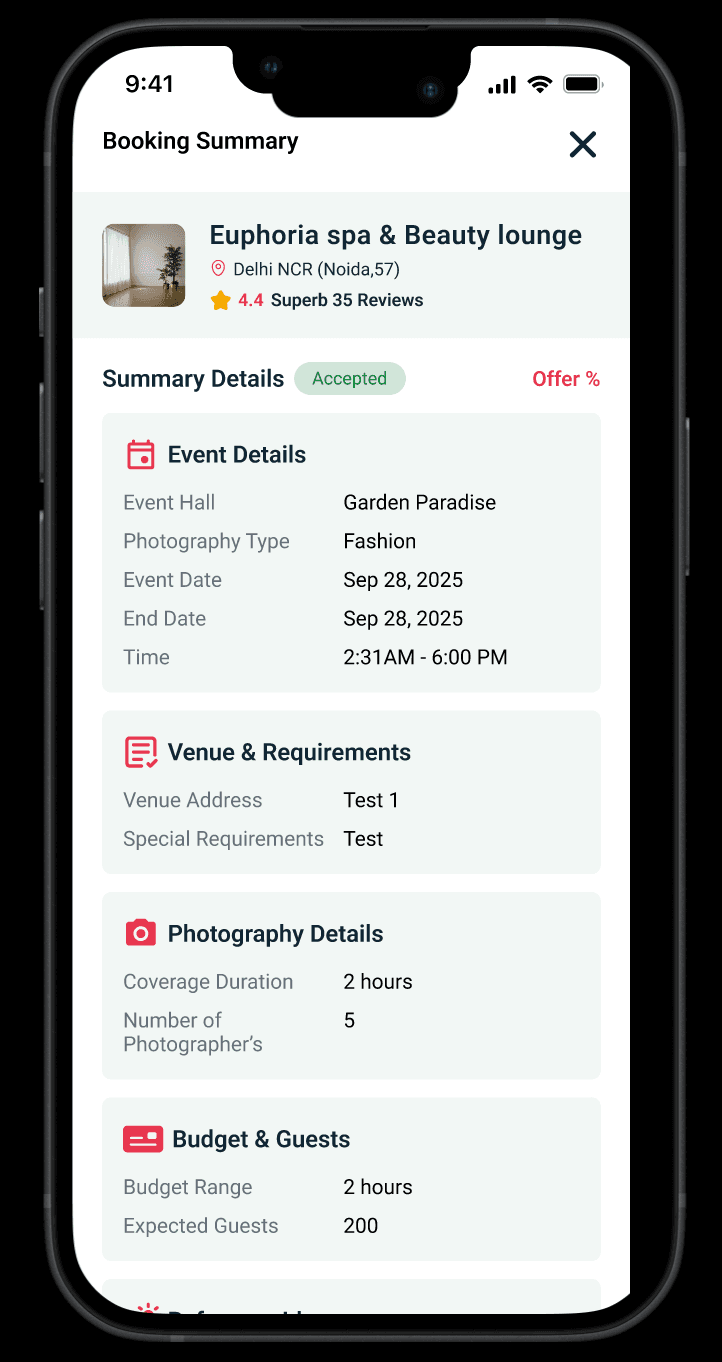
- Booking Tracking — real-time status (Pending, Approved, Completed) with structured event detail summaries
- Notifications — real-time push notifications via FCM for booking alerts, quote updates, and status changes
- Vendor Dashboard — lead and enquiry management, listing and pricing control, booking tracking, and quote response tools
- Admin Panel — user and role management (RBAC), vendor and venue management, booking dashboard, dynamic form builder, quotation management, and content management (policies, FAQs, feedback)
- Authentication — email/password, OTP login, Google Sign-In, secure session handling, and optional biometric authentication on mobile
Visual Language
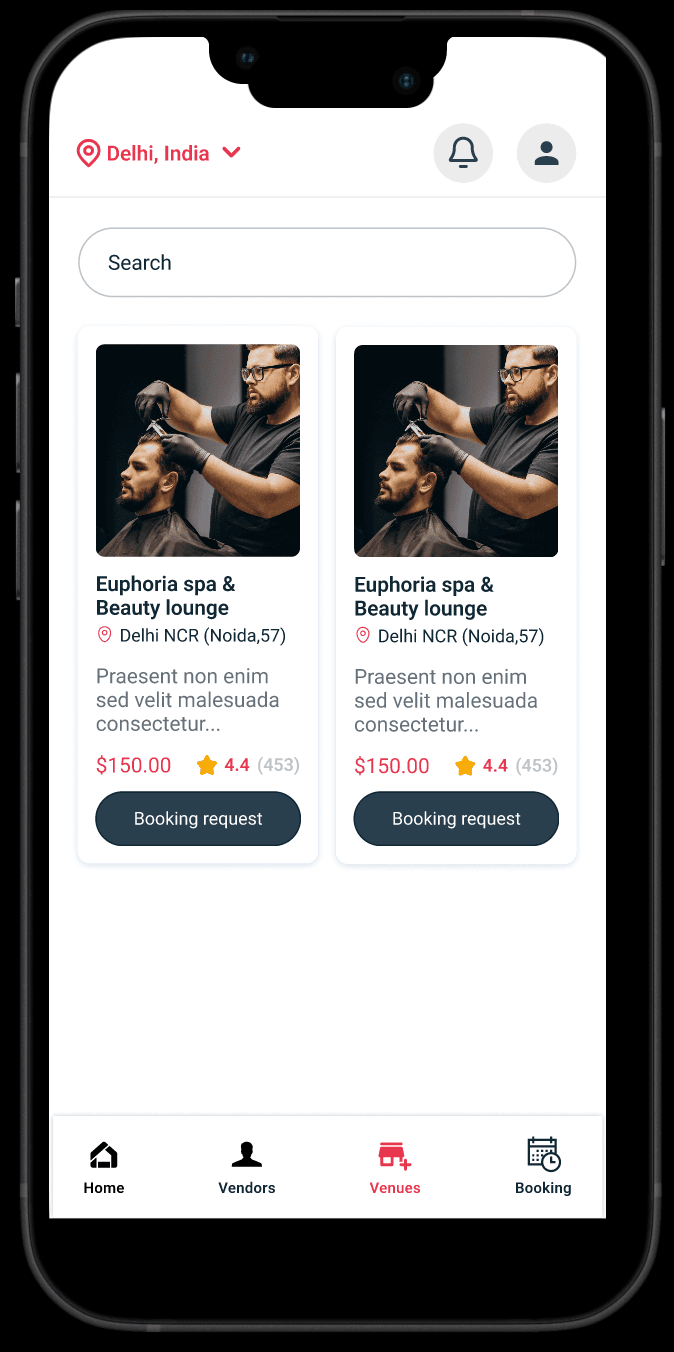
The web platform was built with React.js — responsive across all screen sizes, with dynamic dashboards and listing interfaces designed for both end users and vendors. The Flutter mobile app was designed for speed and clarity — rich venue and service detail pages, smooth navigation across services and bookings, and a booking summary experience that surfaces structured event details without cognitive overload. The admin panel prioritised density and control, giving the operations team full visibility and action capability across every entity in the system.
Wireframes & Early Ideas
Early wireframes focused on the two highest-complexity flows — the booking request and quote workflow, and the vendor detail page. The multi-step booking flow required particular care: too many steps and users dropped off, too few and the quote exchange felt abrupt. The vendor detail page went through several iterations to balance the photo gallery, pricing information, reviews, and the booking trigger without any one element dominating. The admin dynamic form builder — which allows category-specific booking inputs without code changes — was prototyped early to validate the approach before backend implementation began.
Designing Solutions
Problem: Users had no way to discover, compare, and book services in one place
- Built a unified discovery layer with location-based search (GPS + manual city/area selection), category-driven browsing, and featured vendor recommendations
- Vendor detail pages consolidate pricing, photo albums, reviews, map location, and similar service recommendations — all the information needed to make a booking decision without leaving the platform
- MongoDB's flexible schema supports dynamic service categories without structural changes — new categories and cities are added through the admin panel, not code

Problem: No structured booking workflow — coordination happened entirely offline
- Built a complete multi-step booking engine — Request → Quote → Accept/Reject → Completion — with full history, cancellation, and modification support
- Vendors receive structured booking requests and respond with quotes through the platform — no external communication needed
- Booking status is tracked in real time (Pending, Approved, Completed) and visible to both user and vendor — no ambiguity about where a booking stands
Problem: Vendors had no tools to manage leads, listings, or bookings at scale
- Built a full vendor dashboard for listing management (pricing, albums, availability), lead and enquiry tracking, quote response, and booking history
- Admin quotation management system gives operators visibility into all quotes and the ability to intervene or manage disputes
- RBAC-based access control separates vendor capabilities from admin capabilities — vendors see and manage only their own data
Problem: Operations team needed full platform control without developer involvement
- Built a comprehensive admin panel covering user and role management, vendor and venue oversight, booking dashboard with filters and status tracking, and content management for policies and FAQs
- Dynamic form builder allows category-specific booking input fields to be configured by admins — no code change required when adding new service types
- All marketing content (featured vendors, FAQs, policies) is API-driven and fully managed through the admin panel
Tech & Implementation
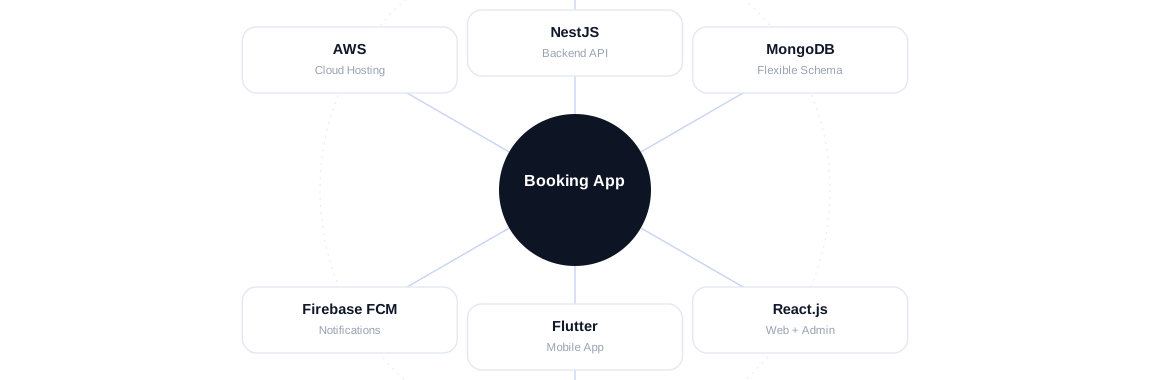
- Backend: NestJS — RESTful API architecture, JWT authentication, OTP flows, booking lifecycle management, FCM notification integration, modular service design
- Database: MongoDB — flexible schema for dynamic service categories, optimised queries for high-volume booking data, scalable structure for vendors, venues, and users
- Frontend (Web): React.js — responsive admin and web platform, dynamic dashboards, vendor and booking control interfaces, listing management
- Mobile: Flutter — cross-platform iOS and Android, smooth UI/UX for discovery and booking, real-time API integration, location-based service discovery
- Authentication: JWT + OTP flows, Google Sign-In, secure session handling, optional biometric authentication
- Notifications: Firebase Cloud Messaging (FCM) — real-time push for booking alerts, quote updates, and status changes
- Hosting: AWS — scalable Node infrastructure for the backend, CDN delivery for the web frontend
- Storage: Cloud storage (S3) for media assets — venue photos, vendor albums, and user-uploaded content
- Database hosting: Managed MongoDB cluster for high availability
- Deployment: CI/CD pipelines with version-controlled automated deployments
Real-world Features & Highlights
- Location-based discovery → GPS and manual area selection surfaces the most relevant vendors and venues instantly
- Multi-step booking engine → Request → Quote → Accept/Reject → Completion with full history, cancellation, and modification
- Vendor detail pages → pricing, photo albums, reviews, map location, and similar service recommendations in one view
- Real-time booking status → Pending, Approved, Completed — visible to both user and vendor without refresh
- Push notifications → real-time FCM alerts for every booking event, quote update, and status change
- Flutter mobile app → cross-platform iOS and Android with full booking and discovery capability
- Dynamic form builder → category-specific booking inputs configured by admins without code changes
- Admin panel → user, vendor, booking, quotation, and content management with RBAC-based access control
- Google Sign-In and biometric authentication → fast, secure access across platforms
- Managed MongoDB cluster → flexible schema supports new categories and cities through admin, not code
Results & Impact
- Manual vendor coordination eliminated entirely — all discovery, comparison, quoting, and booking happens within the platform
- Significant improvement in booking efficiency — users complete the full journey from discovery to confirmed booking without leaving the app
- Vendor onboarding and engagement increased — structured lead management and booking tracking gave vendors the tools they were missing
- Real-time, location-based decision making enabled for the first time — users book with confidence based on proximity, price, and reviews
- Operations team manages the full marketplace independently — new categories, vendor listings, and content updates require no developer involvement
- Future-ready scalable marketplace foundation — new cities and service categories are added through admin configuration, not architecture changes

Challenges & Learnings
- Multi-tenant architecture — designing a system where users, vendors, and admins all operate on the same data with strict role separation required careful RBAC design from day one, not retrofitted later
- Dynamic form builder — allowing admins to define category-specific booking input fields without code changes required a flexible form schema in MongoDB and a robust rendering layer in both web and mobile
- Quote workflow complexity — the Request → Quote → Accept/Reject flow had more edge cases than anticipated (expired quotes, rejected and re-quoted, partially accepted) and required disciplined state machine design
- Location accuracy — GPS-based discovery worked well in dense urban areas but required fallback to manual city and area selection for users in lower-coverage zones
- Real-time consistency — ensuring booking status updates reached both the user and vendor simultaneously via push notifications required careful event sequencing on the server side
Takeaways
- Marketplaces are two-sided products: Every feature decision affects both users and vendors — designing for one without considering the other creates imbalance that surfaces in low vendor engagement or user drop-off
- The booking engine is the product: Discovery drives traffic but the booking workflow is what delivers value — getting the Request → Quote → Approval flow right was the most important engineering decision on the project
- Flexibility beats rigidity in marketplace schemas: MongoDB's document model meant new service categories with entirely different booking inputs could be added through admin configuration — a relational schema would have required migrations for each new category
- Admin tools determine operational scalability: The dynamic form builder and content management system meant the client could onboard new service types and cities without any developer involvement — that independence was as valuable as the platform itself
- Real-time is a trust signal: Instant booking status updates and push notifications weren't just UX improvements — they directly reduced user anxiety and support queries by eliminating the "did my booking go through?" uncertainty
Next Steps
- Production payment gateway integration — in-app payment for bookings with receipts, refund handling, and vendor payout statements
- Seller / vendor portal enhancements — analytics dashboard showing enquiry rates, booking conversion, and revenue per listing
- Advanced search and filtering — full-text search, price range, date availability, and rating filters as the vendor catalogue grows
- Review and rating system — post-booking review flow with verified purchase validation
- Multi-language and multi-currency support — for expansion into new regions without forking the codebase
- AI-powered recommendations — personalised vendor suggestions based on booking history and browsing behaviour
Client Feedback
"WhizCloud took our vision of a unified service marketplace and turned it into a fully working platform faster than we expected. The booking engine works exactly as we needed — the quote and approval flow has transformed how our vendors manage requests. What stood out was their ability to think about both sides of the marketplace — the user experience and the vendor tools — at the same time. The admin panel gives us complete control, and the dynamic form builder means we can launch new service categories ourselves. A platform we are genuinely proud of."
— Smart Booking Marketplace Client
Call to Action
If you are looking to build a service marketplace, booking platform, or multi-vendor discovery system across web and mobile, contact us at WhizCloud — we'd love to partner with you.
Contact Us