Amazon Ads Intelligence Platform — A Case Study
Turning Amazon marketplace chaos into actionable insights with a full-stack ads analytics and automation platform
TL;DR
We built Amazon Ads Intelligence Platform, a full-stack SaaS platform for a US-based company serving Amazon vendors, sellers, and ad agencies. Using Node.js, Angular, MongoDB, and Redis — with full Amazon Ads API and SP-API integration — the platform consolidates ad and sales data, automates reporting, and enables real-time campaign control. The result: 25% faster report delivery, 30–40% improvement in ad spend efficiency, 100% automated data aggregation, and a live platform that continues to expand across new Amazon marketplaces.

Problem Overview
The client needed to consolidate Amazon Advertising and sales data into actionable insights. Account managers manually pulled metrics — CTR, conversion rate, ACOS, ROAS — from Seller and Vendor Central, tracked them in fragmented spreadsheets, and had no way to act on them in real time. The result was slow, error-prone reporting and no campaign control at scale.
- Manual data extraction from Seller and Vendor Central was time-consuming and error-prone
- ROAS, ACOS, CTR, and conversion metrics tracked in disconnected spreadsheets with no unified view
- No real-time visibility into campaign performance — decisions were always made on stale data
- No automated bidding — ad spend optimisation relied entirely on manual intervention
- Growing client base created scaling issues that ad-hoc tools and Excel reports could not handle
Role & Responsibilities
- Role: Full-stack development team
- Responsibilities:
- Design and build the full SaaS platform — frontend, backend, ETL pipelines, and reporting engine
- Integrate the full Amazon Ads API (Sponsored Products, Brands, Display) and SP-API end-to-end
- Build custom ETL jobs for Amazon DSP ad data for advertising agencies
- Develop the Bridge Analysis engine, Report Center, and Data Master modules
- Implement automated bidding and campaign control features
- Build role-based access control for sellers, vendors, agencies, and admins
- Architect the system for multi-account, multi-brand, and multi-marketplace scalability
- Ongoing support, feature expansion, and Amazon API schema updates
Project Context
- Client: US-based SaaS company serving Amazon vendors, sellers, and ad agencies
- Industry: AdTech and e-commerce analytics
- Purpose: Centralise Amazon ad and sales data, automate reporting, and build optimisation tools that give account managers real-time campaign control
- Constraints: Amazon API throttling limits, MWS to SP-API migration during deprecation, multi-market data complexity (USA, UK, and more), and strict compliance with Amazon's security protocols
My Approach
We started by mapping exactly where account managers lost time and accuracy — data extraction, report generation, and manual bid adjustments were the three biggest bottlenecks. The architecture was built around a high-performance ETL pipeline as the foundation, with the analytics and automation layers built on top. Building for multi-account and multi-marketplace scale was a design requirement from day one, not retrofitted later.
- Discovery: Audited the existing manual workflow — from raw data extraction to final report delivery — and identified every point of friction
- ETL-first architecture: Designed the data pipeline before any frontend work — reliable ingestion was the prerequisite for everything else
- API strategy: Integrated the full Amazon Ads API and latest SP-API, covering Orders, Inventory, Payments, Settlements, Forecasting, and Analytics
- Iterative delivery: Rolled out modules incrementally — reporting first, then Bridge Analysis, then automated bidding — validating each with the client before proceeding

Research & Insights
Key Findings from Discovery
- Account managers spent significant time each week manually pulling the same reports from Seller and Vendor Central — fully automatable work
- No single tool covered the entire Amazon stack — teams stitched together partial solutions and spreadsheets
- ACOS and ROAS changes were visible in the numbers but no one could explain what drove them — the Bridge Analysis concept came directly from this gap
- Agencies managing multiple brands needed consolidated multi-account views that no existing tool provided cleanly
- Bid management was entirely manual — there was no automation even for straightforward optimisation rules
Competitive Research
- Ad-hoc spreadsheets and partial tools dominated — no competitor covered the full Amazon Ads and SP-API stack in one place
- Existing reporting tools produced static outputs — none offered a proprietary insight engine explaining performance changes
- Most platforms required significant manual configuration; none offered presentation-ready automated reports from a template library
User Persona
- Name: Alex
- Role: Amazon account manager at an e-commerce agency
- Goals: Understand campaign performance instantly, optimise bids without manual work, deliver polished reports to clients without spending hours compiling data
- Pain Points: Hours lost to manual data extraction, no way to explain ACOS changes to clients, Excel reports that go stale before they're sent

Information Architecture
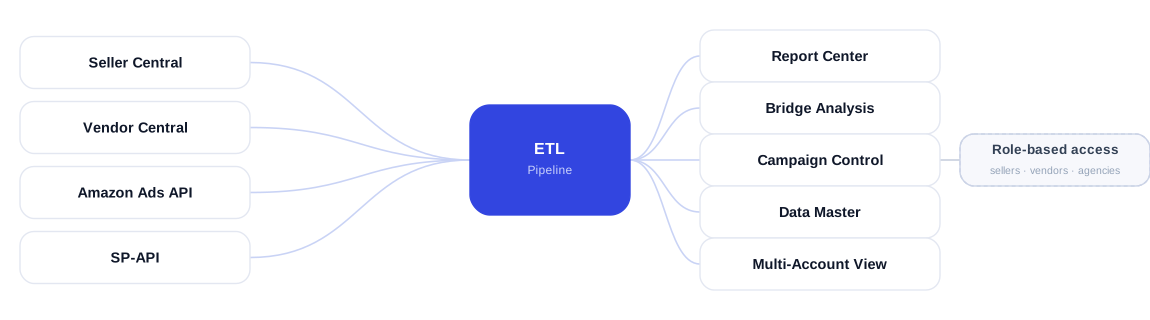
- ETL Pipeline — efficient data extraction and transformation via Amazon SP-API and Ads API across all connected accounts
- Report Center — presentation-ready multi-account, multi-brand Amazon reports generated from a template library on demand
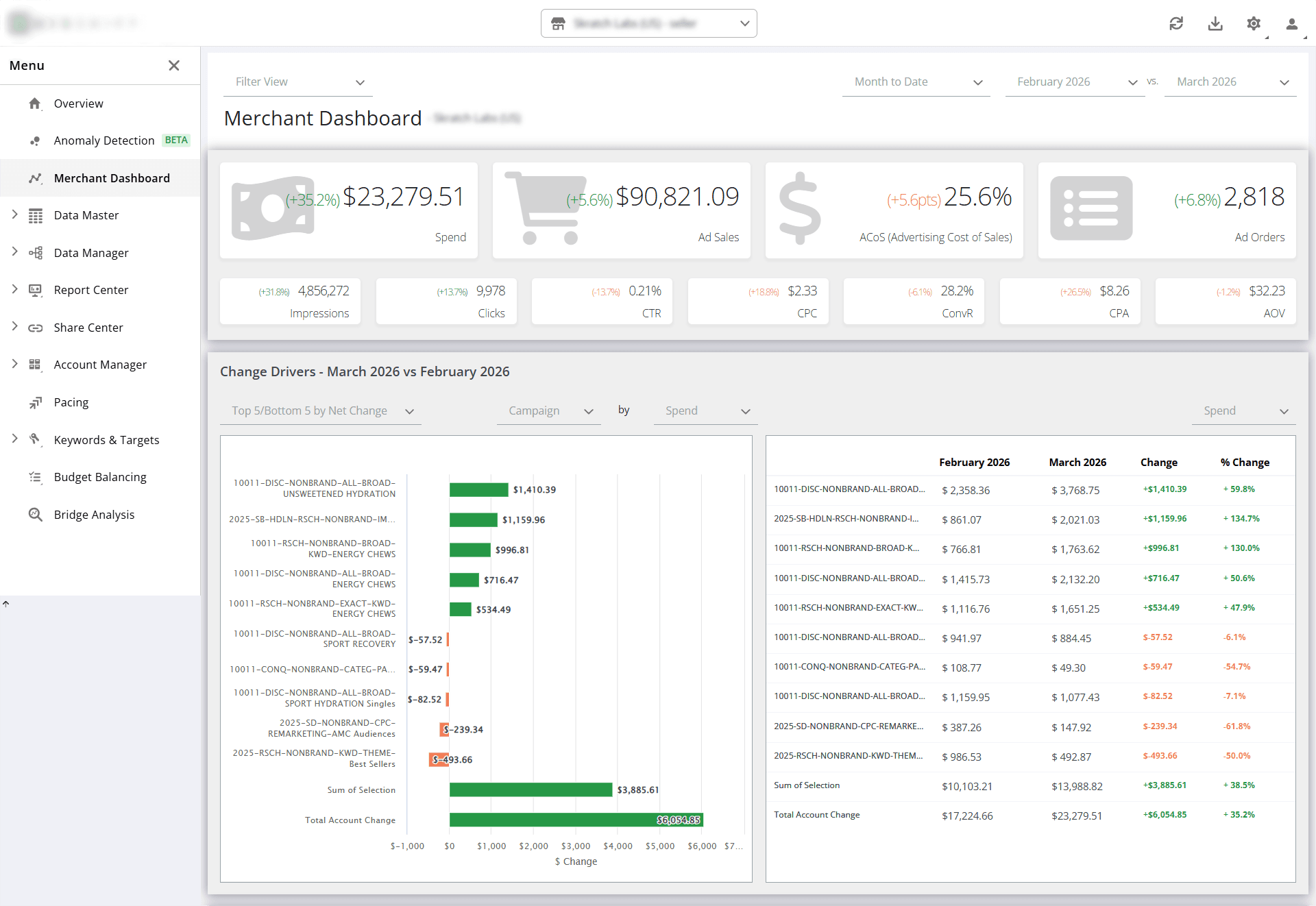
- Bridge Analysis Engine — proprietary insight module that identifies what drove ACOS and ROAS changes down to keyword level
- Campaign Control Center — real-time campaign monitoring and automated bid management running on autopilot
- Data Master — interactive analytics interface that replaces spreadsheets with a live, queryable data view
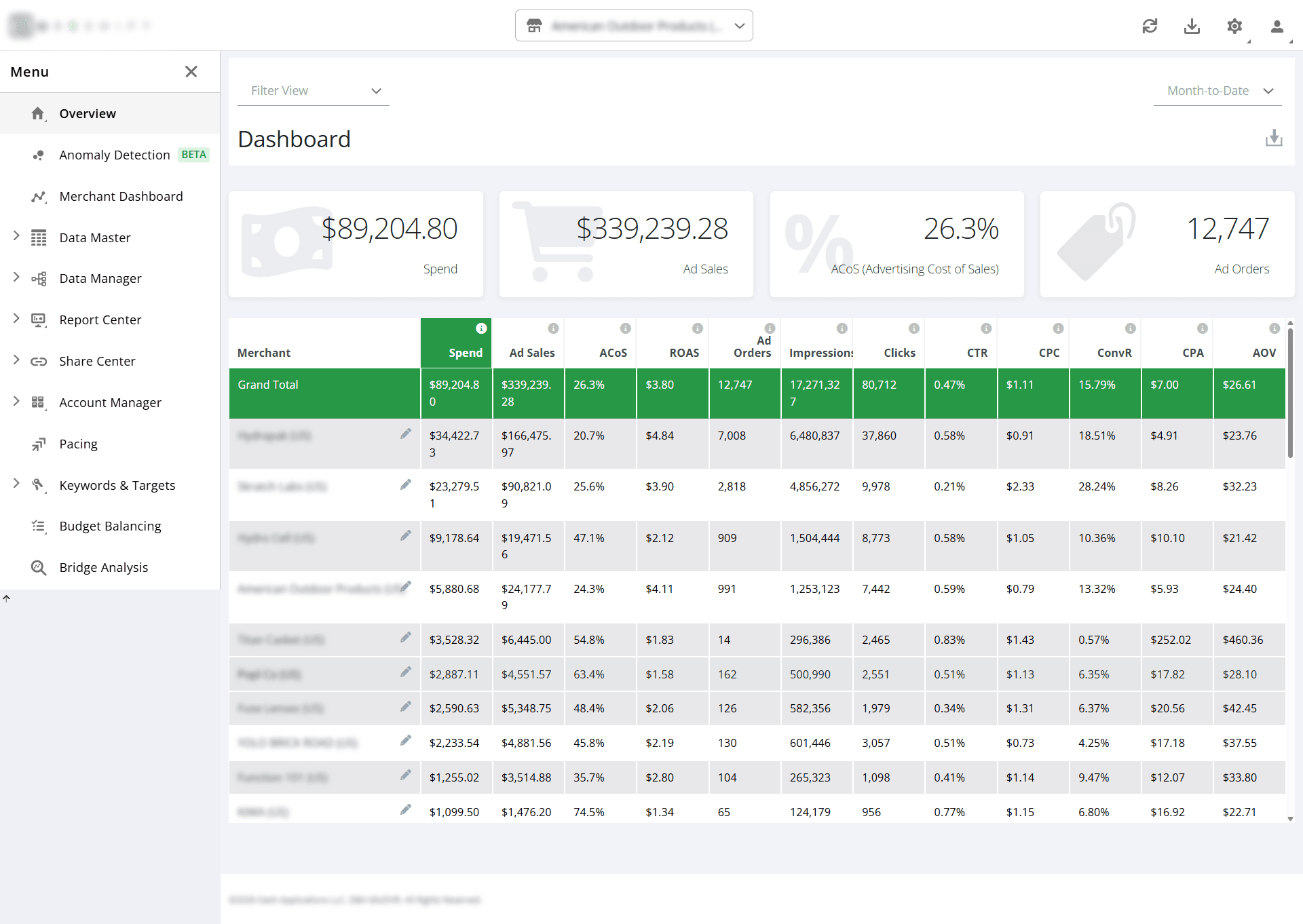
- Multi-Account Dashboard — consolidated KPI and performance views for agencies managing multiple sellers and brands
- Role-Based Access — secure permission layers for sellers, vendors, agencies, and admins
Visual Language
The platform was designed for account managers and agency teams who live inside dashboards all day. Angular enabled a dynamic, scalable, and responsive frontend with real-time KPI views and campaign metrics at a glance. The Report Center was designed to produce presentation-ready outputs — clients described the reporting as "magnificent" for its ease — so visual polish and clarity were as important as the data accuracy behind them.
Wireframes & Early Ideas
Early wireframes focused on the Report Center and the Bridge Analysis view — the two features that most directly addressed the client's biggest pain points. A key early decision was to make Bridge Analysis a standalone module rather than burying it in a general dashboard, giving it the prominence it deserved as a differentiator. The Data Master interface went through multiple iterations to balance analytical depth with accessibility for non-technical users.
Designing Solutions
Problem: Manual data extraction from Seller and Vendor Central was slow and error-prone
- Built automated ETL pipelines that extract, transform, and load Amazon ad and sales data continuously via SP-API
- Custom ETL jobs written for Amazon DSP ad data, covering Orders, Inventory, Payments, Settlements, Forecasting, and Analytics
- 100% automated data aggregation — human error in data pulling eliminated entirely

Problem: No unified view of campaign performance — metrics tracked in fragmented spreadsheets
- Report Center generates presentation-ready multi-account, multi-brand reports from a template library — on demand, not manually compiled
- Data Master provides an interactive analytics interface where users can query and explore live data without spreadsheets
- Multi-account dashboard gives agencies a consolidated view of all sellers and brands in one place
Problem: No way to explain what drove ACOS and ROAS changes
- Built Bridge Analysis — Amazon Ads Intelligence Platform's proprietary insight engine that identifies performance drivers down to keyword level
- Gives account managers a clear, client-ready explanation of why metrics changed and where to focus next
- Transforms performance data from a number to a narrative — a major differentiator in client conversations
Problem: Bid management was entirely manual with no optimisation at scale
- Automated bidding system directly targets ACOS and ROAS goals — campaigns optimised on autopilot
- Real-time Campaign Control Center monitors live performance and applies bid changes without manual intervention
- Result: 30–40% improvement in ad spend efficiency post-launch
Tech & Implementation
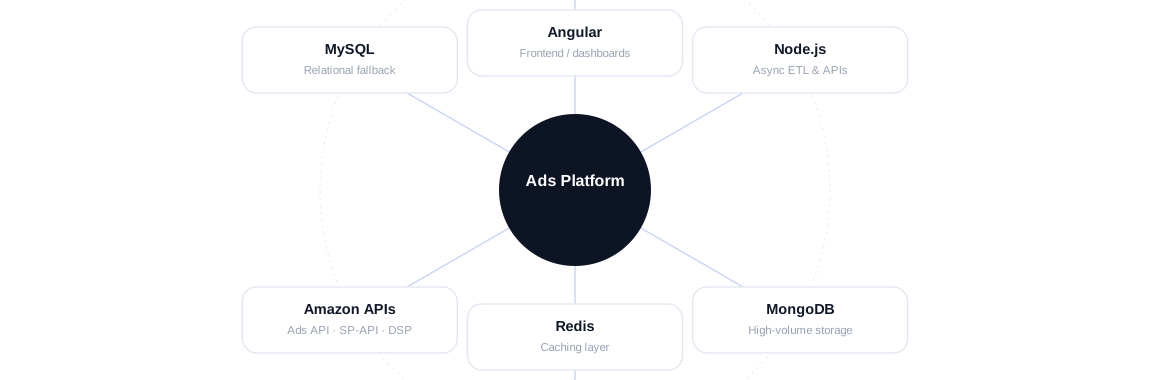
- Frontend: Angular — dynamic, scalable, and user-friendly dashboard interface with real-time data rendering
- Backend: Node.js — chosen for asynchronous nature and suitability for ETL pipelines and high-performance APIs
- Database: MongoDB for high-volume Amazon data ingestion with scalability across global regions; MySQL as a fallback for smaller workloads
- Caching: Redis for improved caching and batch performance across reporting and ETL jobs
- Amazon Integrations: Full Amazon Ads API (Sponsored Products, Brands, Display); latest SP-API (Orders, Inventory, Payments, Settlements, Forecasting, Analytics); Amazon DSP for advertising agencies
- Architecture: Microservices and cloud infrastructure enabling horizontal scaling as client volume grows
- Deployment: CI/CD pipeline with ongoing support, monitoring, and Amazon API schema update routines
Real-world Features & Highlights
- Automated ETL pipelines → 100% automated data aggregation from Amazon Ads API and SP-API
- Report Center → presentation-ready multi-account, multi-brand reports from a template library on demand
- Bridge Analysis → proprietary engine identifying ACOS and ROAS performance drivers down to keyword level
- Automated bidding → campaigns optimised on autopilot targeting ACOS and ROAS goals
- Campaign Control Center → real-time monitoring and bid management across all connected accounts
- Data Master → interactive analytics interface replacing spreadsheets with live queryable data
- Multi-account dashboard → consolidated KPI views for agencies managing multiple sellers and brands
- Role-based access → secure permission layers for sellers, vendors, agencies, and admins
Results & Impact
- 25% faster report delivery — automated scripts eliminated manual compilation and human error entirely
- 30–40% improvement in ad spend efficiency — automated bidding directly targeted ACOS and ROAS goals
- 100% automated data aggregation — no manual data pulling from Seller or Vendor Central
- Client expanded to more Amazon marketplaces post-launch and continues to onboard new vendors onto the platform
- Positive client feedback on the intuitive UI and custom reporting — reporting described as "magnificent" for its ease
- Amazon Ads Intelligence Platform is a live, ongoing SaaS platform — WhizCloud continues to add new report types, custom dashboards, and Amazon API updates as they release

Challenges & Learnings
- MWS to SP-API migration — managing the transition within Amazon's deprecation timeline without disrupting live data flows required careful planning and parallel running
- API throttling — implementing real-time data processing within Amazon's strict rate limits required smart queuing and retry logic throughout the ETL layer
- Multi-market complexity — handling data across USA, UK, and other marketplaces efficiently was complex; schema and currency normalisation had to be built into the pipeline from the start
- Bridge Analysis accuracy — building an insight engine that correctly attributes ACOS changes to specific keywords required significant iteration and validation against real campaign data
- Amazon security compliance — ensuring the platform met Amazon's security and data handling protocols throughout the integration process was non-negotiable
Takeaways
- ETL quality is the foundation: Every analytics feature, insight, and automation depends on clean, reliable data — getting the pipeline right before building anything else was the most important architectural decision
- Cover the full stack: Integrating all Amazon Ads and SP-API endpoints in one place — rather than partial coverage — is what separated Amazon Ads Intelligence Platform from ad-hoc tools and made it genuinely useful at scale
- Insights beat data: Bridge Analysis proved that clients don't just want numbers — they want to understand what changed and why; proprietary insight engines are a stronger differentiator than better dashboards
- Build for scale from day one: MongoDB, microservices, and a schema designed for large volume meant adding new clients and marketplaces required provisioning compute, not rearchitecting
- Ongoing partnership drives platform quality: Maintaining Amazon API compatibility as endpoints change and adding features iteratively based on client feedback kept Amazon Ads Intelligence Platform relevant and growing
Next Steps
- Custom dashboards for brand comparisons across multiple marketplaces
- New report types based on expanding client needs and Amazon reporting endpoints
- Deeper DSP analytics for advertising agency clients
- Predictive ACOS and ROAS modelling using historical campaign data
- Continued marketplace expansion support as clients scale to new Amazon regions
Client Feedback
"Working with WhizCloud on Amazon Ads Intelligence Platform has been an excellent technical partnership. They demonstrated deep Amazon API expertise, responded quickly to our evolving requirements, and scaled the platform rapidly as our client base grew. Their ability to translate complex advertising data into intuitive, presentation-ready reporting has been a standout — our clients have described the reporting as magnificent. We value their responsiveness, technical depth, and commitment to keeping the platform current as Amazon continues to evolve its APIs."
— Amazon Ads Intelligence Platform Client, US-based AdTech Company

Call to Action
If you're looking to build an Amazon analytics platform, automate ad reporting, or integrate deeply with Amazon Ads and SP-API, contact us at WhizCloud — we'd love to partner with you.
Contact Us