
Smarter financial tracking with AI-powered insights and real-time advice.
A personal finance platform that combines expense tracking with dual AI insights — NestJS, Flutter, MongoDB, OpenAI, and Gemini — so users can parse bank statements, follow spending, and get contextual financial guidance.
Money tools were fragmented, static, and rarely personal.
Users juggled expense logging, bank statement reconciliation, and generic tips that never adapted to their real transactions or context.
No real-time transaction streams
Traditional apps missed SMS-based notifications and live spending updates.
Static dashboards
Charts showed history without predictive or contextual insight.
Generic financial advice
Tips ignored the user’s actual spending patterns and goals.
Tedious statement analysis
Bank PDF/CSV review and categorization was manual and error-prone.
Client
Client-funded mobile-first product
Industry
Personal finance & FinTech
Integrations
OpenAI · Gemini · FCM · OAuth
Engagement
12-week end-to-end MVP
What we learned before we designed anything
Interviews with working professionals and competitor reviews of Mint and YNAB shaped a mobile-first product with privacy and personalization at the center.
Real-time sync is table stakes
Users expected bank and SMS transactions to land without manual logging.
Advice must feel personal
Generic tips failed — guidance had to reflect the user’s own history and goals.
Security is a trust gate
Privacy and auth concerns ranked as high as feature depth.
Mobile-first wins daily use
Cross-platform Flutter reach was critical for habit-forming finance tracking.
AI needs a human tone
Users rejected robotic chatbot language — advice had to sound natural and contextual.
Tracking without intelligence
Many apps log expenses well but stop short of personalized, conversational guidance.
Weak statement automation
PDF/CSV bank uploads often still need heavy manual cleanup.
One-size advice
Static tip libraries rarely adapt to live transaction context.
Rahul Verma
Mid-level IT professional
Goals
- • Track spending accurately
- • Plan savings and avoid debt
- • Get advice that fits my finances
Pain Points
- • Manual expense logging
- • No personalized advice
- • Confusing dashboards
Transactions in, clarity and advice out.
SMS and uploads feed a NestJS + MongoDB core; OpenAI and Gemini power categorization and chat; Flutter delivers charts, alerts, and the AI assistant on iOS and Android.
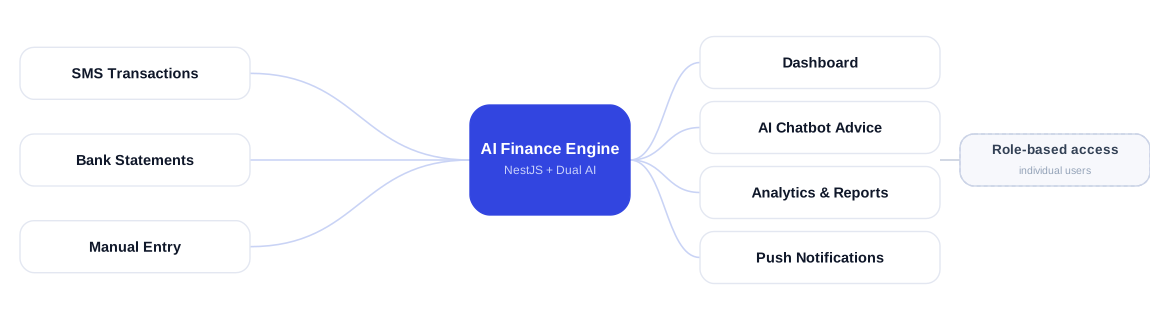
One finance system, from capture to counsel.
Tracking, statement intelligence, and chat share the same user context so advice always reflects real spending.
Users missed live spends and relied on delayed, manual entry.
SMS parsing plus smart manual entry
- ✓SMS-based transaction parsing with unified history
- ✓Manual entry with autocomplete when automation needs a hand
Bank statements were tedious to categorize and summarize.
Upload, categorize, chart automatically
- ✓PDF/CSV upload with AI-assisted categorization on MongoDB
- ✓Spending summaries rendered as clear Flutter charts
Financial tips felt generic and disconnected from the user’s data.
Contextual advice with dual AI engines
- ✓Gemini-powered chat grounded in the user’s transaction context
- ✓OpenAI + historical context for ongoing, personalized guidance
Dashboards were noisy and hard to act on day to day.
Income vs expenses at a glance
- ✓Clean analytics for patterns, budgets, and savings forecasts
- ✓Firebase push reminders and spending alerts on mobile
Built for mobile-first AI finance.
NestJS and MongoDB for scale, Flutter for reach, dual AI for insights, and AWS/Docker ops for a production-ready MVP.
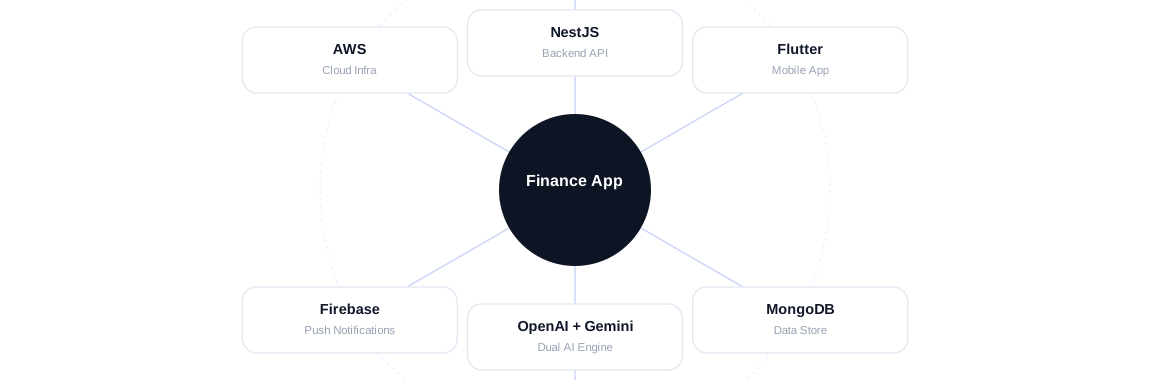
Research, ship mobile, then tune the advice.
Two-week sprints moved from competitor research to Flutter + NestJS delivery, then prompt tuning against real transaction samples.
Research & ideation
Studied Mint and YNAB and interviewed working professionals about daily money friction.
Design & build
Shipped Flutter for cross-platform UX and NestJS for APIs, auth, and AI integrations.
Statement & SMS pipelines
Implemented bank upload parsing, categorization, and SMS-based transaction capture.
Dual AI advice
Wired OpenAI and Gemini with chat history so guidance stayed contextual over time.
Harden & launch MVP
Added OAuth/JWT/OTP, FCM alerts, Docker/Nginx/PM2 deployment, and Swagger docs.
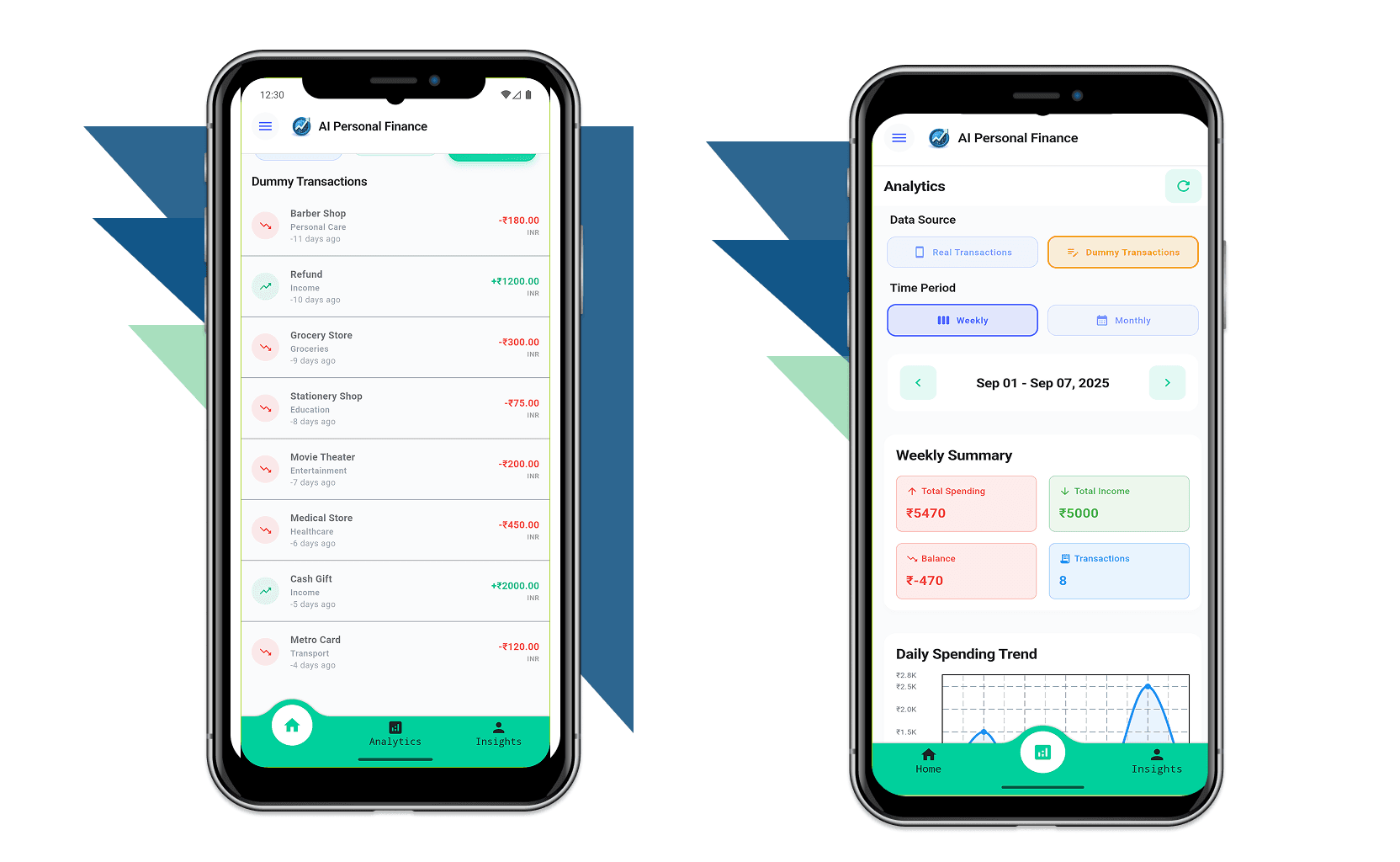
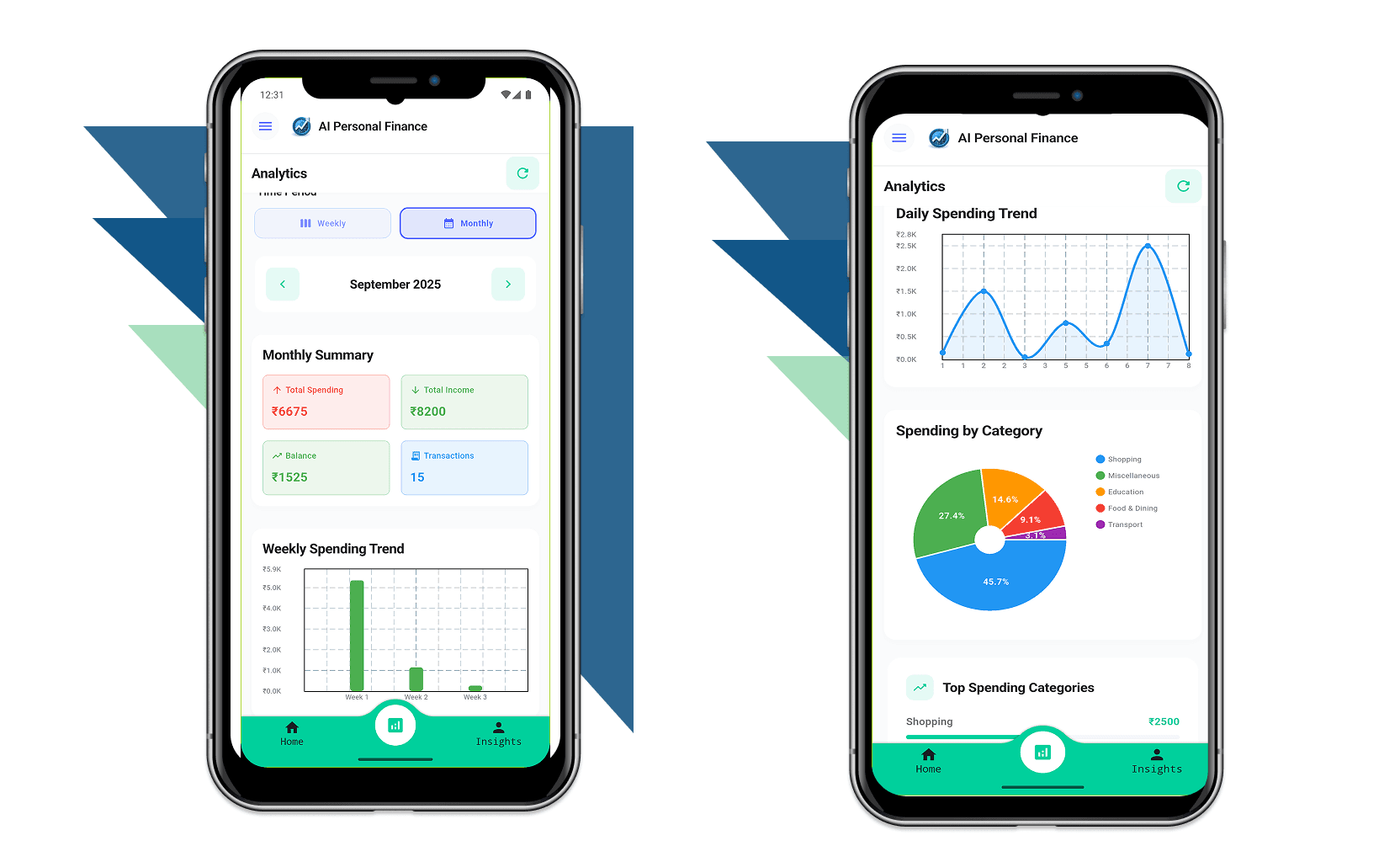
What users open every morning
What changed after launch
2x faster financial tracking - Automated capture and categorization beat manual logging for everyday spending review.
Higher daily engagement in pilot - Active usage grew as users returned for insights and chat, not only transaction entry.
Advice that felt personal - Users reported guidance that reflected their finances instead of generic tips.
Cross-platform Flutter app - One codebase delivered iOS and Android with charts, notifications, and AI chat.
Foundation for premium AI budgeting - Architecture left room for subscription tiers and deeper predictive budgeting.
Production-ready ops baseline - Docker, Nginx, SSL, and CloudWatch monitoring supported a stable MVP rollout.
Challenges & Learnings
SMS parsing across banks
Formats varied by bank — localization and resilient parsers were required.
Financial prompt accuracy
AI advice needed careful prompt tuning to stay useful and responsible.
Human-like chatbot tone
Users wanted conversational guidance, not robotic finance jargon.
Trust via visualization
AI plus clear charts built more confidence than AI answers alone.
Privacy expectations
Auth, secure storage, and transparent data handling were non-negotiable.
Where the platform goes from here
Finally, advice that feels like it’s about my finances, not generic tips.
“The AI finance app made tracking feel automatic and advice feel personal. SMS capture, statement uploads, and the chatbot came together into one mobile experience we could trust day to day.”