
Turning multi-format documents into structured, compliant 1004 appraisal reports.
An AI document platform that classifies, extracts, and standardises PDFs, scans, images, handwritten notes, and DOCX into audit-ready 1004 appraisal reports — using OCR, LLM extraction, and intelligent data mapping.
Inputs were chaotic; outputs had to be perfectly standardized.
Document-heavy industries receive inconsistent formats while regulated reports demand strict structure — creating delays, errors, and compliance risk.
Multi-format chaos
PDFs, images, scans, handwritten notes, and DOCX arrived with no shared structure.
Mixed noisy content
Tables, paragraphs, handwriting, and poor scans defeated simple parsers.
Manual extraction risk
Hand keying was slow, error-prone, and hard to scale without more headcount.
Strict output compliance
1004 appraisal reports required accurate, complete, schema-aligned fields every time.
Client
Document processing enterprise
Industry
Real estate · lending · insurance
Integrations
OCR · LLM · S3 · LangChain
Engagement
Production-ready AI pipeline
What we learned before we designed anything
Discovery showed real documents rarely match templates — context understanding and validation matter more than brittle rules.
Templates fail in the wild
Real-world packets rarely follow consistent layouts or field positions.
Most data is unstructured
Critical fields live in paragraphs, tables, scans, and handwriting — not clean forms.
OCR alone is not enough
Text recognition without contextual understanding still misses meaning and mapping.
Manual work caps scale
Throughput only grew when teams hired more people to key the same fields.
Accuracy is compliance-critical
Wrong fields in appraisal outputs create audit and lending risk.
Template-first extractors
Most tools depend on fixed layouts and break when documents vary.
Narrow format support
Limited handling of mixed scans, handwriting, and DOCX in one pipeline.
Weak validation loops
Few systems treat completeness and accuracy checks as a first-class stage.
David
Appraisal Analyst
Goals
- • Convert packets into standardized reports quickly
- • Cut manual extraction effort
- • Keep outputs accurate and compliant
Pain Points
- • Inconsistent input formats
- • Time-consuming extraction
- • Error risk and hard-to-scale volume
Any document in, validated 1004 report out.
Ingestion and preprocessing feed LLM extraction and schema mapping; a validation engine gates the final standardized report into storage.
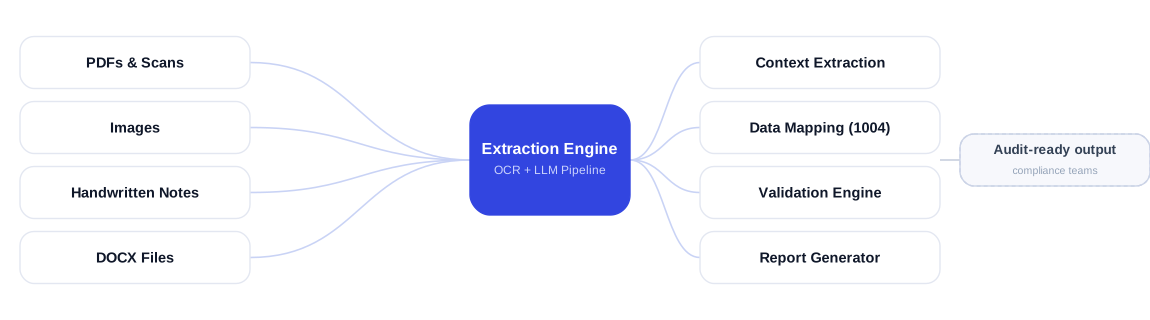
Transformation, not just extraction.
The pipeline understands context first, then maps meaning into the rigid 1004 schema with validation before release.
Each format needed different tools and tribal knowledge to open and read.
One pipeline for every packet
- ✓Accepts PDFs, images, scans, handwritten notes, and DOCX in a single flow
- ✓Removes dependency on the source document’s original layout
Rule and template extractors failed on unstructured and noisy content.
Context-aware field understanding
- ✓LLM extraction identifies meaning instead of chasing fixed coordinates
- ✓OCR preprocessing cleans scans and handwriting before reasoning
Getting data into the regulated 1004 shape was a manual remapping exercise.
Schema-aligned structuring
- ✓Maps extracted fields into the standardized 1004 appraisal schema
- ✓Keeps outputs consistent across wildly different inputs
Automation without checks created silent errors and compliance exposure.
Accuracy-gated report generation
- ✓Validation engine checks completeness and correctness before release
- ✓Automated generation of audit-ready standardized reports
Built for messy inputs and strict outputs.
Node.js and Python services, multi-engine OCR, LLM APIs, and LangChain/LangGraph orchestration on cloud storage and scalable infra.
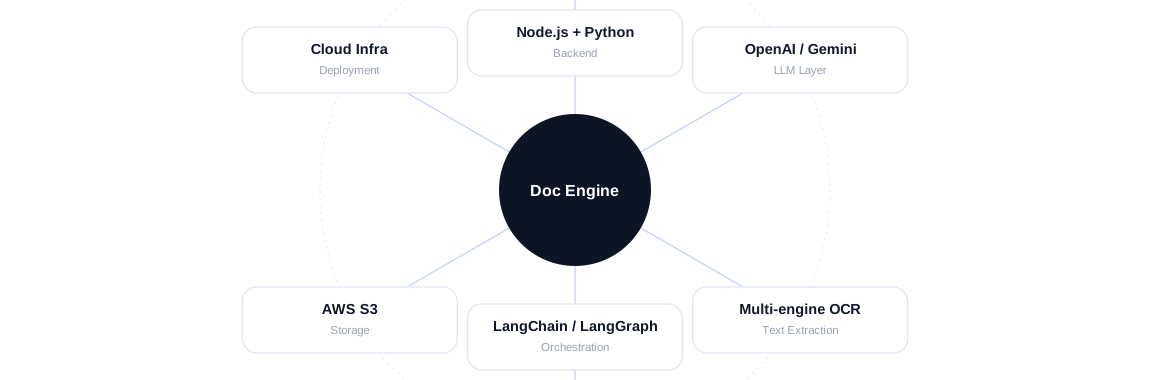
Context first, then structure, then validate.
We treated the problem as intelligent transformation — modular stages for ingestion, extraction, mapping, and validation instead of a brittle parser.
AI-first architecture
Chose LLM contextual understanding over template-only extraction for unpredictable packets.
Unified ingestion
Built one preprocessing path for every supported format, including noisy scans.
Extraction & mapping
Implemented contextual field extraction and intelligent mapping into the 1004 schema.
Validation engine
Added accuracy and completeness checks so automation could meet compliance bars.
Cloud scale-out
Deployed modular backend services and S3-backed storage for high-volume processing.
What analysts run on every packet


What changed after launch
Manual data entry drastically reduced - Automation replaced hours of keying for multi-format appraisal packets.
Faster document processing - End-to-end throughput improved from hours of work toward minutes per standardized report.
Higher accuracy and consistency - Contextual extraction plus validation improved field quality across document types.
Standardized outputs every time - Diverse inputs landed in the same compliant 1004 structure.
Scalable high-volume operations - Modular automation grew capacity without a matching rise in headcount.
Any-format intake - Teams stopped rejecting or reworking packets just because the source format varied.
Challenges & Learnings
Poor-quality scans
Strong preprocessing was required before OCR and extraction could succeed.
OCR inconsistencies
Fallback strategies were needed when engines disagreed or failed on handwriting.
Fixed-schema mapping
Fitting diverse inputs into a rigid 1004 layout took iterative mapping rules.
Flexibility vs standardization
Balancing open intake with strict output compliance was the core design tension.
Validation is non-optional
Production trust depended on completeness checks, not extraction alone.
Where the platform goes from here
This system transformed our document processing workflow. What used to take hours now takes minutes, with better accuracy and consistency. The ability to handle any format is a game changer.
“WhizCloud built an AI standardization pipeline that understands messy packets and still lands compliant 1004 outputs. Manual extraction dropped, accuracy improved, and we can finally scale without hiring in lockstep with volume.”