
From email-driven shipping ops to one self-service digital front door.
Partner Shipping — an integrated digital platform for a global container shipping carrier that connects schedule discovery, quotes, bookings, tracking, claims, and content publishing into a single ecosystem backed by live enterprise integrations.
Customer interactions were fragmented across email, PDFs, and spreadsheets.
Quotes took days. Bookings were re-keyed. Tracking required phone calls. Claims arrived as narrative emails. Marketing waited on developer releases — and shippers expected self-service.
Email-driven quotes
Quotes returned days later as unstructured PDFs — extending sales cycles and consuming commercial teams.
Spreadsheet bookings
Bookings required re-keying into operational systems, causing errors and duplicated effort.
On-request tracking
Updates delivered by phone or email generated high service volume and eroded trust.
Opaque claims & content bottlenecks
Claims lacked structured evidence; marketing depended on developer release cycles.
Client
Global container shipping carrier
Industry
Maritime logistics & B2B shipping
Integrations
Schedule · Pricing · Tracking · Claims
Engagement
Full digital platform delivery
What we learned before we designed anything
Findings from shippers, commercial teams, and operations — the basis for every portal, integration, and self-service decision that followed.
Shippers want end-to-end self-serve
Dependency on email for quotes, bookings, and tracking was a source of frustration and lost trust.
Commercial time wasted on prep
Manual quote preparation and booking re-keying should have been automated.
Claims were slow and opaque
Customers lacked status visibility; admins lacked structured evidence to process efficiently.
Content blocked by releases
Marketing could not respond quickly to market changes without engineering involvement.
Enterprise systems stay
Any new platform had to integrate deeply — replacing core ops systems was not an option.
Email still dominates carriers
Most container lines still relied on email workflows for quotes and bookings.
Disconnected tracking portals
Tracking tools existed apart from booking and claims, forcing multi-tool juggling.
No unified authenticated ecosystem
Few competitors joined quotes, bookings, tracking, claims, and CMS in one place.
Marcus
Logistics Manager · B2B Shipper
Goals
- • Book quickly with accurate pricing
- • Track containers in real time
- • File and monitor claims without chasing email
Pain Points
- • Waiting days for quotes
- • Re-keying booking data
- • No claim status visibility
Four independently evolvable layers, one shipping experience.
Customer Portal, Claims Portal, Integration Platform, and Headless CMS — API-first so enterprise system changes never cascade into customer-facing code.
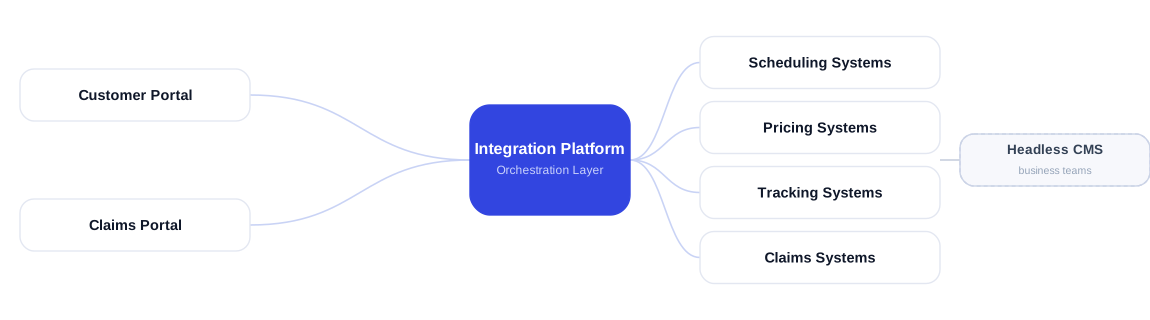
Self-service as the default across the shipment lifecycle.
Quotes, bookings, tracking, claims, and content share one authenticated ecosystem orchestrated through the integration layer.
Quotes requested by email returned days later as unstructured PDFs.
Instant indicative pricing from live data
- ✓Schedule-integrated quoting with live enterprise schedule and pricing — no manual PDF prep
- ✓One-click quote-to-booking conversion that transfers all data automatically
Bookings submitted as spreadsheets requiring re-keying into operational systems.
Structured multi-step ocean freight booking
- ✓Cargo, dangerous goods, parties, and documents validated at entry
- ✓Integration layer routes complete data directly to downstream operational systems
Tracking updates delivered by phone or email on request.
On-demand container visibility
- ✓Operational datalake integration — not manually updated status fields
- ✓Event-driven notifications for shipment lifecycle milestones
Claims filed as narrative emails; marketing waited on developer releases.
Guided claims and headless publishing
- ✓Claims Portal with structured evidence, admin review, settlement, and enterprise handoff
- ✓Headless CMS with 20+ templates so business teams publish without engineering
Built for enterprise logistics depth and independent evolution.
Modular API-first architecture with containerised cloud deployment, RBAC and 2FA, CDN-backed content, and live enterprise integrations for schedule, pricing, tracking, and claims.
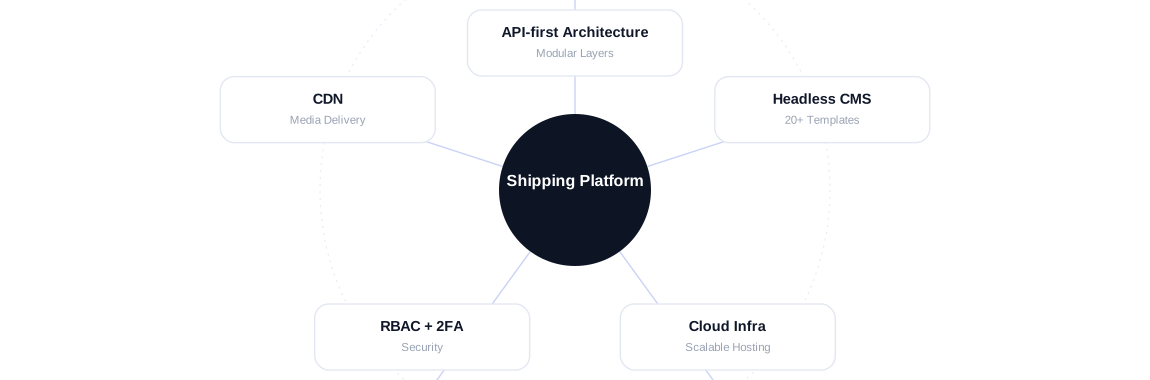
Map the shipper lifecycle, then separate the layers.
Experience, integration, content, and infrastructure were designed to evolve independently without cross-layer disruption.
Discovery
Mapped every customer touchpoint handled by email, phone, or spreadsheet — and the enterprise systems feeding each one.
Modular architecture
Designed Customer Portal, Claims Portal, Integration Platform, and Headless CMS as independently evolvable capabilities.
API-first design
Built experience apps to communicate exclusively through the integration layer.
Self-service workflows
Delivered quotes, bookings, tracking, and claims designed for completion without manual ops responses.
Security & launch
Shipped encrypted auth, RBAC, 2FA, bot protection, audit logging, and event-driven notifications.
What shippers see across the Partner Shipping ecosystem
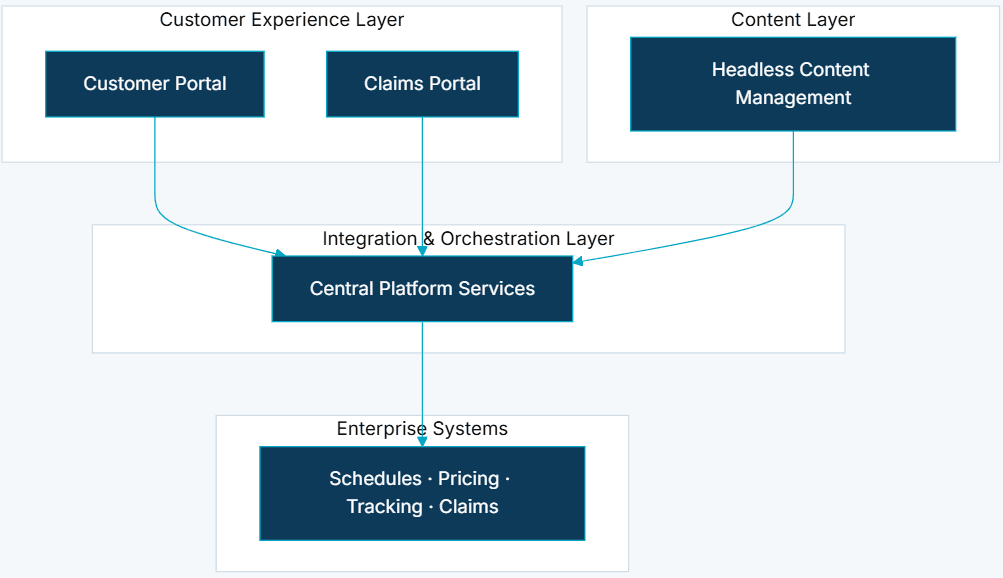
What changed after launch
Self-service end-to-end - Shippers complete quotes, bookings, tracking, and claims without waiting for manual responses.
Single customer dashboard - Active quotes, confirmed bookings, and claim status visible in one place.
Eliminated re-keying - Structured digital intake delivers complete, validated data on first submission.
Automated lifecycle notifications - Confirmations and status updates replace routine manual communication.
Live enterprise data - Schedule, pricing, tracking, and claims integrate with operational systems — not static publications.
Governance and auditability - Audit logging, RBAC, and content trails support regulated B2B shipping operations.
Challenges & Learnings
Enterprise integration without replacement
Robust integration had to tolerate upstream data variability without modifying core systems.
Keeping layers truly separate
API-first discipline prevented ops changes from cascading into customer-facing disruptions.
Claims workflow complexity
Evidence states, admin review, and settlement had to satisfy shippers and enterprise processing.
Headless CMS adoption
Templates and editorial workflow had to match how business teams think about content.
Audit trail as product
Designing auditability into every transaction from the start built platform trust.
Where the platform goes from here
Partner Shipping has fundamentally changed how our customers interact with us. What used to require emails, phone calls, and manual back-and-forth now happens instantly through the platform.
“Our commercial teams are focused on winning business rather than preparing PDFs, and our customers trust us more because they can see exactly what is happening with their shipments at any time.”