Digital Commerce Platform — A Case Study
Unifying a customer ecommerce storefront with admin ERP operations for a specialist horticultural retailer
TL;DR
We built a Digital Commerce Platform for a specialist horticultural and gifting retailer, joining a public ecommerce storefront with a comprehensive back-office administration and ERP capability. Using Angular for the storefront and admin portal, Node/Express APIs for both customer and admin services, and integrations including Stripe, Paysafe, Contentful, Searchspring, Klaviyo, Feefo, FreshDesk and SendGrid/Mandrill, the platform supports product discovery, specialist plant content, customer accounts, promotions, cart and checkout, payment orchestration, fulfilment preparation, inventory control, supplier purchasing, reporting and operational governance. The result: a unified digital operating model that connects customer experience, commerce data and fulfilment execution.
Problem Overview
The client needed to give customers a fast, content-rich buying journey for plants, trees, hedging, gifts and other specialist product categories, while keeping internal operations — catalog, customer, order, fulfilment, purchasing and reporting — coordinated across ecommerce and warehouse activity. Seasonal demand, complex product availability and delivery rules meant that manual intervention on every transaction was no longer sustainable.
- Customers needed a guided, content-rich buying journey for plants, trees, hedging, gifts and specialist categories
- Seasonal demand, product availability complexity, delivery rules and order changes required handling without manual intervention on every transaction
- Catalog, customer, order, fulfilment and reporting workflows spanned ecommerce, warehouse operations and supplier purchasing with no single source of truth
- Operational visibility was limited for stock, future workload, order preparation, refunds, payments, customer communications and content quality
- Digital marketing and customer engagement needed support through newsletters, advice content, product reviews, search feeds and external platforms
Role & Responsibilities
- Role: Full-stack development team
- Responsibilities:
- Design and build the customer storefront, customer API, admin portal and admin API as a connected platform
- Implement catalog browsing, search, product detail pages, cart, checkout, promotions and payment capture for the storefront
- Build admin ERP capability covering order preparation, barcode scanning, stock movement, purchasing and warehouse operations
- Integrate Stripe, Paysafe, Contentful, Searchspring, Klaviyo, Feefo, FreshDesk, SendGrid/Mandrill and AWS-backed media/file services
- Deliver role-based admin authentication, permissions and route-level access controls
- Build data-heavy reporting across stock, orders, sales, VAT, customer activity and website quality
Project Context
- Client: Specialist horticultural and gifting retailer
- Industry: Ecommerce and retail operations
- Purpose: Give customers a guided digital buying journey while giving internal teams a unified platform for commerce, fulfilment and reporting
- Constraints: Seasonal demand spikes, complex product availability and bundle rules, blocked shipping dates and delivery timetables, multiple external service integrations, and the need for secure, role-based admin access across operational teams
My Approach
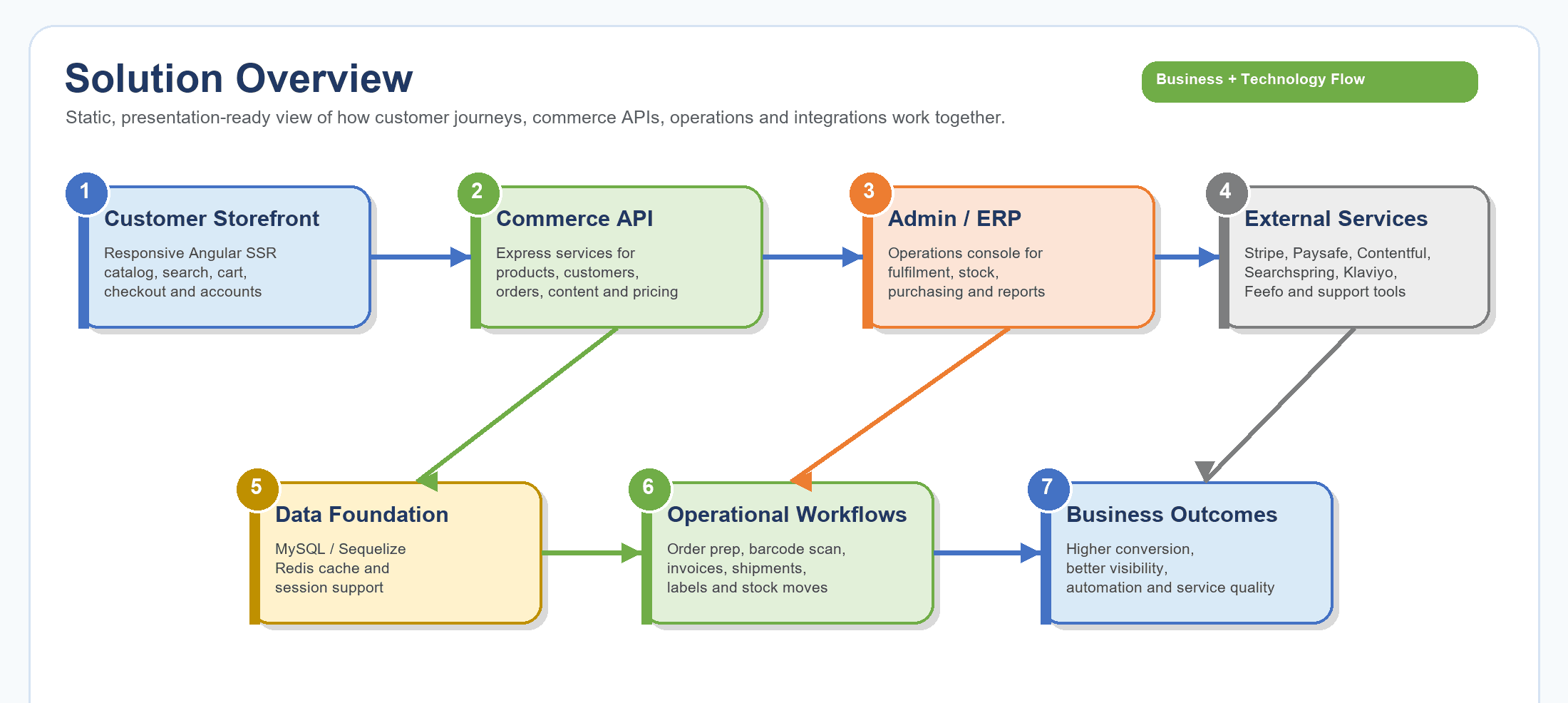
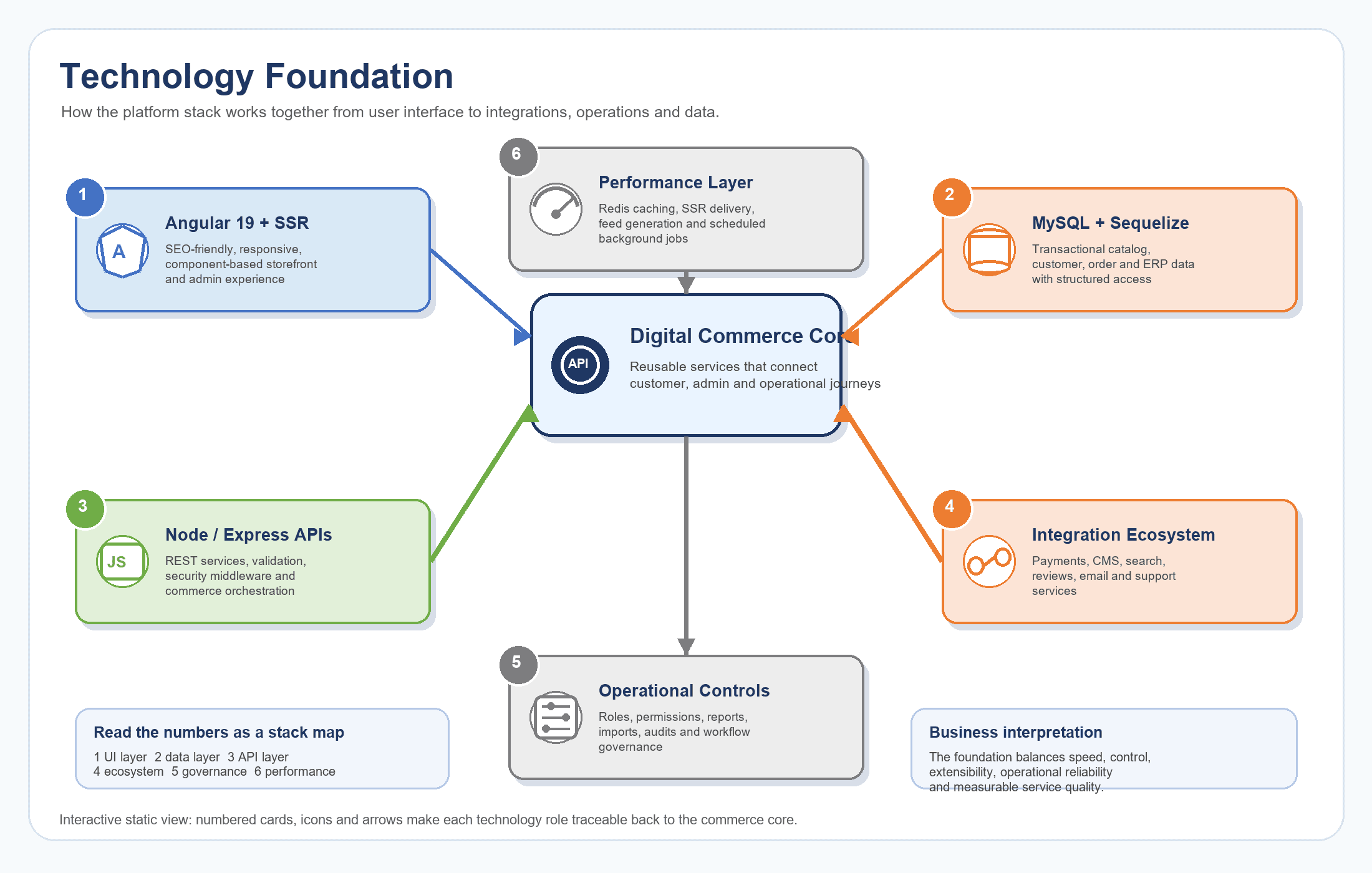
The implemented solution combines a customer storefront and an admin ERP portal over a shared set of Node/Express APIs and transactional data services. Angular server-side rendering improves public-site discoverability and perceived performance, while API services isolate business logic for products, customers, orders, promotions, payments, content and operational workflows.
- Discovery: Mapped the full journey from catalog discovery and specialist content through to checkout, fulfilment, supplier purchasing and reporting
- Platform Strategy: Organized the solution around four major applications — the Angular storefront, Node/Express customer API, Angular admin portal, and Node/Express admin API
- SSR for Discoverability: Used Angular server-side rendering to keep the storefront responsive and SEO-friendly while loading complex catalog, product, advice and promotion data
- Operational Automation: Built automation for fulfilment documents, plant labels, supplier notifications, order comments, invoices, shipments and credit memos directly into the admin API
Research & Insights
Key Findings from Discovery
- Customers needed more than static product listings — specialist tools such as a plant finder and pollination checker were essential to a horticultural buying journey
- Internal teams were working across fragmented operational tools rather than one coordinated workspace, increasing manual coordination effort
- Seasonal demand and product availability complexity meant fulfilment and stock processes needed to be resilient to change, not just accurate at a point in time
- Marketing and content teams needed advice, blogs, banners, CMS pages, newsletters and feeds to stay aligned with seasonal campaigns
- Data-heavy reporting across stock, orders, sales, VAT, customer activity and website quality needed to remain usable, not just available
Competitive Research
- Specialist retail competitors typically separated storefront and operations tooling, creating coordination gaps between sales and fulfilment
- Few platforms combined specialist content (advice, plant finder, pollination checker) with transactional commerce in one experience
- Operational reporting in comparable platforms was often fragmented across systems rather than centralised in a single admin workspace
User Persona
- Name: Alex
- Role: Operations and fulfilment lead
- Goals: Prepare orders quickly and accurately, keep stock and supplier purchasing aligned with demand, give commercial and customer service teams clear visibility into orders and exceptions
- Pain Points: Fragmented operational tools, manual coordination between sales and warehouse activity, limited visibility into future workload and stock exceptions, slow communication with customers and suppliers
Information Architecture
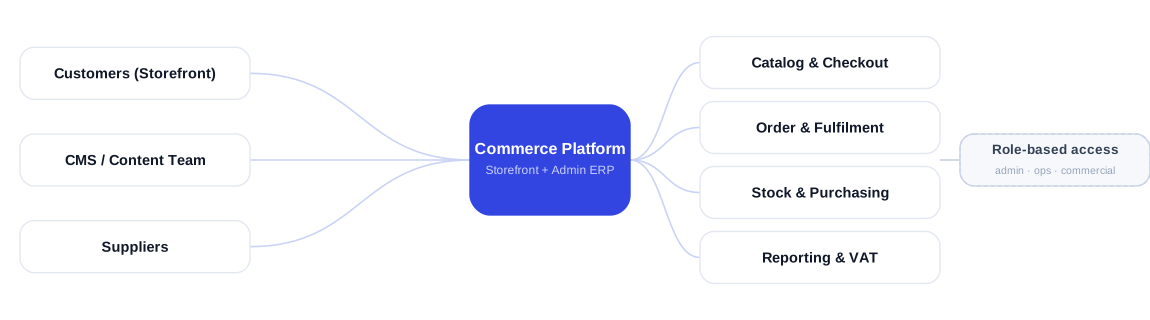
- Customer Storefront — catalog browsing, search, product detail pages, account management, wish lists/favorites, cart, checkout, payment status, blogs, advice, newsletters, static pages, gift vouchers, plant finder and pollination checker
- Admin Portal — catalog and category management, order management, barcode scanning, order preparation, stock movement, mass stock editing, purchasing, suppliers, warehouse operations, roles, permissions, reports, CMS, media and email templates
- Integration Services — payments, CMS imports/webhooks, search feeds, marketing feeds, customer service tickets, product reviews, sitemap and Google feed generation
- Operational APIs — automation for fulfilment documents, plant labels, supplier notifications, order comments, invoices, shipments, credit memos and workflow-specific reports
- Governance Layer — admin authentication, roles, permissions, configuration, email templates, imports/exports and audit-oriented operational reports
Visual Language
The storefront was designed to make specialist horticultural content and a wide product catalog feel approachable, guiding customers through categories, search, product recommendations, availability data and specialist tools rather than presenting raw catalog data. The admin portal was designed around clarity for operational teams, prioritising the views that operations, customer service and commercial teams use most.
Wireframes & Early Ideas
Early design work centred on the customer journey from category browsing through to checkout, and on the admin order-preparation workflow — the two areas where the most time would be spent. A key decision was to surface specialist tools such as the plant finder and pollination checker alongside standard catalog browsing rather than treating them as separate features, and to design the admin portal as a single role-based workspace rather than a set of disconnected operational screens.
Designing Solutions
Problem: A static buying journey could not support specialist horticultural products or seasonal demand
- Built guided customer journeys with categories, search, product recommendations, availability data, advice and specialist tools such as plant finder and pollination checker
- Connected checkout to cart, delivery rules, promotions, gift vouchers, payment providers and order confirmation content as one journey rather than separate steps
Problem: Catalog, customer, order, fulfilment and reporting workflows were fragmented across ecommerce and warehouse operations
- Organized the platform around four connected applications — Angular storefront, Node/Express customer API, Angular admin portal, and Node/Express admin API — sharing the same transactional data services
- Gave internal users a role-based admin workspace covering catalog, order, stock, purchasing and warehouse activity instead of fragmented operational tools
Problem: Limited operational visibility into stock, future workload, order preparation, refunds, payments and content quality
- Built reporting across stock, orders, sales, VAT, customer activity and website quality directly into the admin portal
- Added exception-focused reports for incomplete orders, no-delivery-date orders, out-of-stock messages, orphan products and future workload
Problem: Multiple external services needed to work together without adding fragility
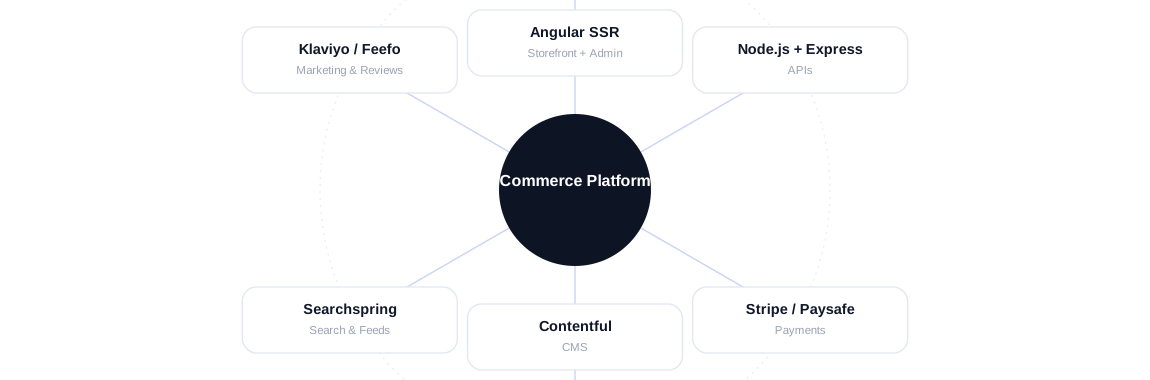
- Integrated Stripe and Paysafe for payments, Contentful for content, Searchspring for search and merchandising feeds, Klaviyo for marketing, Feefo for reviews, FreshDesk for support tickets, and SendGrid/Mandrill for transactional email
- Used AWS-backed media and file operations to support content, imports and exports consistently across the platform
Problem: Product availability, bundles, stock movements and delivery rules added operational complexity
- Built dedicated handling for bundle products, stock movements, blocked shipping dates, delivery timetables and seasonal supply needs
- Added mass stock editing, stock-take workflows and supply-need purchasing to keep stock discipline ahead of demand
Tech & Implementation
- Customer Frontend: Angular with server-side rendering for SEO-friendly, responsive storefront performance
- Customer Backend: Node.js with Express, providing customer-facing APIs for catalog, account, cart, checkout and content
- Admin Frontend: Angular admin portal for catalog, order, stock, purchasing, warehouse and reporting workflows
- Admin Backend: Node.js with Express, providing operational APIs for fulfilment, purchasing, reporting and governance
- Payments: Stripe and Paysafe for payment capture, invoices, shipments, credit memos and refunds
- Content & Search: Contentful for CMS imports/webhooks, Searchspring for search feeds, Google product feeds and sitemap generation
- Marketing & Reviews: Klaviyo for newsletters and marketing, Feefo for product reviews and testimonials
- Support & Communications: FreshDesk for customer service tickets, SendGrid/Mandrill for transactional email
- Media & Files: AWS-backed media and file operations for content, imports and exports
- Security: Admin authentication, roles, permissions and route-level access controls throughout the admin portal
Real-world Features & Highlights
- Unified commerce experience → catalog browsing, product detail pages, search, cart, checkout, promotions, coupons, gift vouchers, payment capture and order history
- Customer engagement tools → accounts, addresses, wish lists, favorites, newsletters, testimonials, product reviews, advice, blogs and contact journeys
- Operational ERP workspace → order preparation, barcode scanning, plant labels, pick lists, stock movements, warehouse views, suppliers and purchase orders
- Content and search integration → CMS pages, static blocks, menus, Contentful imports/webhooks, sitemap generation, Searchspring feeds and Google product feeds
- Payments and finance → Stripe, Paysafe, invoices, shipments, credit memos, refunds, VAT reports and payment transaction reporting
- Governance and control → admin authentication, roles, permissions, configuration, email templates, imports/exports and audit-oriented operational reports
- Mobile-friendly experience → Angular responsive layouts let customers browse, search, save favorites and purchase from mobile browsers, with mobile-friendly accounts and checkout flows reducing friction for returning customers and guest buyers
- Mobile-capable operations → barcode scanning and order preparation routes can support handheld or tablet-based warehouse activity where device access is available
Results & Impact
- Faster fulfilment preparation through selected orders, batch documents, picking lists, plant labels and shipment/invoice creation
- Improved stock discipline with mass stock tools, stock movements, availability reporting, warehouse views, stock take workflows and supply-need purchasing
- Better exception handling through reports for incomplete orders, no delivery date orders, out-of-stock messages, orphan products and future workload
- Reduced manual communication effort through customer emails, supplier notifications, newsletters, review feeds and support ticket integration
- Greater management visibility through sales, banking, VAT, margin, stock valuation, customer, product and website quality reports
- A connected digital operating model where customer experience, commerce data and fulfilment execution reinforce each other
- A platform for scalable seasonal ecommerce, combining SSR storefront performance, cache-backed APIs and operational automation
- Reusable integrations established with marketing, payments, CMS, reviews, search, support and media services
Key Success Indicators
- Commercial Performance: Conversion rate, average order value, repeat purchase rate, successful payment rate and promotion effectiveness
- Customer Experience: Mobile conversion, search success, checkout completion, support contact reduction, review sentiment and account adoption
- Operational Efficiency: Orders prepared per hour, delivery-date accuracy, stock adjustment volume, fulfilment exception count and barcode scanning throughput
- Inventory and Supply: Stock accuracy, out-of-stock incidents, supplier lead-time visibility, purchase order cycle time and supply-need coverage
- Platform Health: API latency, cache hit rate, SSR page performance, payment error rate, feed generation success and integration failure rate
- Governance: Admin role coverage, permission exceptions, audit report usage, import/export accuracy and configuration change traceability
Challenges & Learnings
- Balancing a content-rich, SEO-friendly storefront against the load of complex catalog, product, advice and promotion data required careful use of server-side rendering and caching
- Coordinating customer-facing order flows with back-office fulfilment, stock allocation, invoicing, shipment and refund processes meant treating the storefront and admin portal as one connected system rather than two separate products
- Integrating Stripe, Paysafe, Contentful, Searchspring, Klaviyo, Feefo, FreshDesk, SendGrid/Mandrill and AWS-backed services together required clear ownership boundaries to avoid fragility across the platform
- Managing product availability, bundle products, stock movements, blocked shipping dates, delivery timetables and seasonal supply needs required dedicated rules rather than generic ecommerce logic
- Keeping data-heavy reporting usable across stock, orders, sales, VAT, customer activity and website quality required prioritising the views operational teams actually use day to day
Takeaways
- Commerce and operations are one system: Joining the customer buying journey with back-office fulfilment, stock and purchasing turned two separate efforts into one connected operating model
- Specialist content drives specialist commerce: Tools like the plant finder and pollination checker were as important to the buying journey as cart and checkout
- Server-side rendering is a business decision, not just a technical one: SSR directly supported discoverability and seasonal sales performance, not only page-load metrics
- A role-based admin workspace reduces coordination cost: Replacing fragmented operational tools with one portal reduced manual coordination across order preparation, stock and purchasing teams
- Reporting only helps if it's usable: Data-heavy reporting across stock, orders, sales, VAT and customer activity needed to be organised around operational decisions, not just data availability
Next Steps
- Extend predictive stock and supply-need planning ahead of seasonal demand peaks
- Deepen personalization across product recommendations, advice content and promotions
- Expand mobile-optimised operational tools for handheld warehouse and fulfilment use
- Broaden reporting into predictive operational and customer behavior insights
- Extend integration coverage as new marketing, payment and fulfilment partners are added
Client Feedback
Indicative client feedback: The project gives a stronger digital foundation by joining the customer buying journey with the operational controls needed behind the scenes. Teams can manage product, order, stock, content and fulfilment activity from a purpose-built admin portal, while customers benefit from a more guided and reliable online experience.
Customer service teams have better visibility of orders, customer history and support workflows.
Operations teams can prepare orders, print labels, manage stock and monitor future workload from one environment.
Commercial teams can manage promotions, content, pricing, reporting and digital marketing integrations more effectively.
Call to Action
If you're looking to build a unified digital commerce and operations platform, or connect your ecommerce storefront with ERP-grade back-office control, contact us at WhizCloud — we'd love to partner with you.
Contact Us